I believe in strength, conditioning, and mobility. Strength is a transferable skill,and a strong person is likely reasonably mobile and conditioned, with a lifestyle dedicated to health and longevity.
What is strength? Why do we need it?
Webster’s New Universal Unabridged Dictionary (deluxe second edition!) offers nine definitions. My favorites are the first three: 1. the state or quality of being strong; force; power; vigor. 2. the power to resist strain, stress, etc.; toughness; durability. 3. the power to resist attack; impregnability. Notice that the word power appears three times, and twice power is used to resist an outside force.
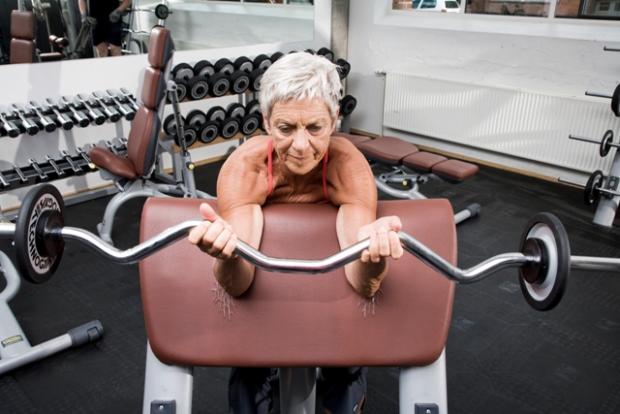
Power, force, vigor, resistance, toughness, durability, impregnability. Pure and unadulterated, these qualities are traditionally and universally admired and sought after, the qualities of superheroes. These are the benefits of strength, and the building blocks of a long, happy life.
Typically, when we speak of physical strength, we’re talking about muscles and the ability to lift heavy things. Strength, and the pursuit of it, is often misunderstood. Perhaps we’re really talking about overall good health.
It’s rare to get to the mid-century mark and not have at least a trace of arthritis. No matter how strong a muscle is, it cannot move a non-functioning joint, but when you load your muscles and move through a full range of motion, you resist the conditions that attack your joints. Movement keeps them at bay, and loaded movement strengthen bones, tendons, and ligaments.
Being strong helps you resist sickness and disease. It’s impossible to be strong and unhealthy. Healthy habits are required to build strength, and being strong helps you avoid getting sick. The strong bones you build become impregnable to osteopenia and osteoporosis, your strong ligaments resist sprains, and your strong tendons resist tearing. Strength training will help you resist the attempts of fibromyalgia and chronic fatigue syndrome to hinder your vigor.
Who doesn’t want vigor, toughness, and durability? Modern society asks us to define ourselves by the amount of stress we accept, venerating those who accept the most. Vigor, toughness, and durability are qualities of strength most palatable to the world at large today. We love energetic people, and people who survive tough times. We love people who last a long time. Strong people are tough, durable, and energetic.
Getting strong requires more than just lifting heavy weights, like a healthy diet and plenty of rest. The same diet of lean protein, fruits and vegetables that builds strong muscles also builds healthy hearts, lungs, and organs. You avoid the complications associated with obesity, like type II diabetes and heart disease. You can manage your digestive system naturally, without the need for supplemental probiotics or over the counter heartburn medicine. Strength training requires a lot of sleep, and I submit that you need a lot of sleep to recover from everyday life, too.
So, we need strength to be powerful, forceful, impregnable, vigorous, tough, durable, and resistant to the attacks of stress and strain. We need strength to be healthy. We need strength to live long, happy lives.
When strength is defined as good health rather than big, bulky muscles, it becomes a highly desirable quality. Instead of the requirement for lifting heavy weights, it becomes the key to the door of life. If we view strength as more than toned arms and six-pack abs, it becomes a noble goal worth pursuing. Living well should not be a chore.
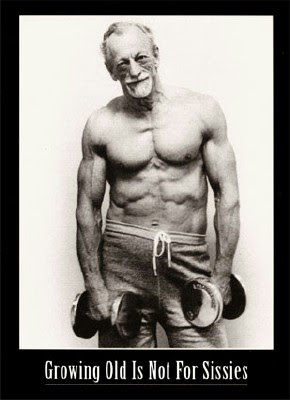
Mark Rippetoe, the Will Rogers of the strength and conditioning world, has said the strong people are generally more useful, and harder to kill. If you’re powerful, forceful, vigorous, and durable, you’re more useful. If you’re tough, impregnable, and resistant to stress and strain, you’re harder to kill.
Reasons enough to be strong, I say.
 mid-century muscle
The points you raise are being driven home almost daily now. A weekend of shoveling and moving dirt exposed weakness in my core and back. In order to fulfill even some of the plans I have for “retirement”, I’ll need to correct that. One of my biggest challenges is getting enough sleep, as I am very undisciplined in that area, and it shows up as an overall sense of lethargy that makes the thought of working out very unappealing.
Great topic, it speaks right to me. Keep it coming!
Greg, it makes sense to me to view strength training as a way to live in a healthy manner, rather than just to have strong muscles. It also seems impossible to me to start doing everything all at once. Once you start training with a purpose, all the other things tend to sort themselves out. It helps me to consider the process more than results. As long as you’re trying, you’re doing. Thanks for reading!
Great piece. I’m sticking to my three strength training sessions per week with my trainer. I’m glad you mentioned sleep, I’ve been sleeping more soundly and just plain needing more sleep to recover. It’s feels great actually.
Muscle soreness has been a bit of a challenge. Should that level off as I get stronger and back in shape? I really enjoy your posts. Keep them coming!
Thanks, Carrie. Sleep is essential for recovery, and a good training program will help you sleep. Trouble sleeping is often a sign of overtraining. Muscle soreness will come and go, depending on your program. Cold showers immediately after training help, if you can stand them, and some folks find relief with tart cherry juice. My favorite protocol is an active recovery day. For instance, after a day of squats and lunges, for instance, a two mile walk will help your legs recover. Massage helps, too.